The Siberian Fox Experiment and the Science of Tameness.
05 October, 2026· Article by Maria Jones

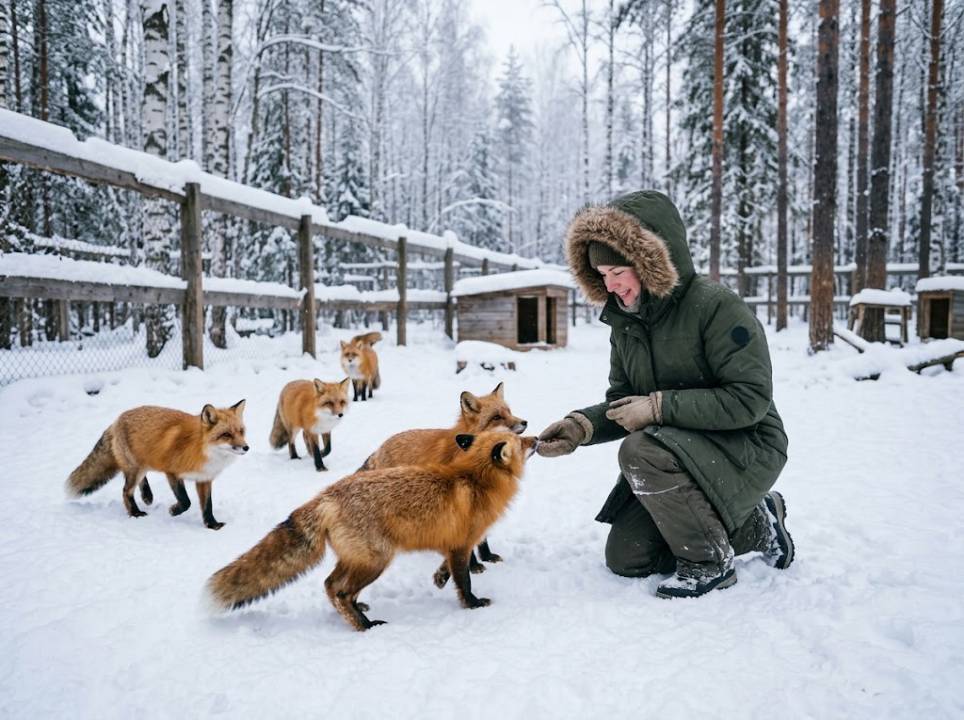
In 1959, on a fur farm outside Novosibirsk, a geneticist named Dmitry Belyaev began an experiment that sounds simple. He would take silver foxes, choose the calmest individuals in each generation and breed only from them. Nothing else would be selected, not coat colour, not size, not shape. Just behaviour.
More than sixty years later, the project is still running. It remains the closest thing science has to watching domestication happen in real time.
Choosing for calm, getting much more
Belyaev and his long-time colleague Lyudmila Trut started with foxes that were fearful or aggressive around people. Within about ten generations, a noticeable share of the selected line approached handlers willingly, wagged their tails and whined for attention. By the thirtieth generation, many behaved much like friendly dogs.
The surprise was what came along with tameness. The domesticated foxes developed piebald coats, floppy ears, curled tails and shorter snouts. Their stress hormone levels dropped. Some had altered breeding seasons. None of these traits had been selected on purpose.
The domestication syndrome
Charles Darwin had already noticed that domesticated animals share a strange set of features, from spotted coats to smaller brains. Scientists now call this the domestication syndrome. The fox experiment offered strong evidence that selecting for reduced fear alone can trigger many of these changes.
One leading explanation involves neural crest cells, a group of embryonic cells that contribute to pigment, cartilage in the ears and face, and the adrenal glands. If selection for calm behaviour subtly reduces the activity of these cells, a whole cluster of physical traits could shift at once.
A research legacy written in Russian
For decades, much of this work was published in Russian journals and reports from the Institute of Cytology and Genetics in Novosibirsk. Western researchers often knew the headline results but not the details: breeding records, behavioural scoring protocols, veterinary notes.
That gap has narrowed. International teams now collaborate with the institute on genome studies, and archival material is gradually being translated. Professional russian translation services play a quiet but real role here, turning decades of lab notebooks and Soviet-era articles into material that geneticists elsewhere can test against their own data.
Large archival projects involve thousands of pages with repeated technical phrases. Teams increasingly rely on translation memory software so that a term like "tameness score" or "elite class" is rendered the same way on page five and page five thousand.
Europe's own contribution
The fox project did not appear in a vacuum. German-speaking ethologists such as Konrad Lorenz had long studied how domestic animals differ in behaviour from their wild relatives, and German zoologists produced detailed comparisons of wolf and dog skulls in the twentieth century. Some of these sources still exist only in German, which is why researchers revisiting them often turn to german to english translation services to check original measurements rather than relying on secondhand summaries.
What the genes say
Modern sequencing has allowed scientists to compare the tame foxes with an aggressive line bred in parallel and with unselected farm foxes. Studies have identified regions of the genome that differ between the lines, including genes linked to social behaviour. Several of these regions overlap with genes associated with sociability in dogs, and even with certain human conditions involving social behaviour.
The overlap suggests that evolution may reuse a similar toolkit whenever animals become more tolerant of others.
Criticism and open questions
Not every scientist accepts the fox experiment as a perfect model. Some point out that the original foxes came from fur farms, where they had already been living with humans for decades and may have carried some of these traits before selection began. Others argue that early dogs were not shaped by deliberate human breeding at all, but by wolves that chose to live near human camps.
These debates are healthy. They push researchers to look at other species, from rats and mink to the wild ancestors of cattle and pigs, to see whether the same patterns appear.
Why it matters beyond foxes
Understanding domestication helps explain how humans came to share their lives with dogs, cats, horses and livestock. It also sheds light on self-domestication, the idea that humans themselves may have evolved to be less aggressive and more cooperative over time.
There are practical lessons too. Animal welfare scientists draw on the fox data to understand stress in farmed species. Conservationists use it to think about how captive breeding programmes might unintentionally make animals tamer and less suited to life in the wild.
The foxes today
The project has faced serious funding challenges since the 1990s, and the population has been reduced. Some tame foxes have even been sold as pets, though experts caution that they remain demanding animals with strong instincts. The core research continues, and new genomic studies keep appearing.
For anyone interested in how wild animals became companions, the Novosibirsk foxes remain essential reading. They show that a single choice, repeated patiently across generations, can reshape a species.
Recent Posts
Vom Wolf zum Hund und was die ...

Domestication du chat, de l’...
Comment l'homme a façonné l'...
Domestication Syndrome: Why Ta...

What Thousands of Years of Evo...

How Domestication Radically Ch...
Share it.

Links
We use cookies
We use cookies to give you the best online experience, remember your preferences, and understand how the site is used. You can accept all cookies, reject optional ones, or choose which categories to allow.
Privacy PolicyCookie preferences
Choose which cookies we can use. Necessary cookies stay on because the site cannot work without them.
For more details, read our Privacy Policy.