

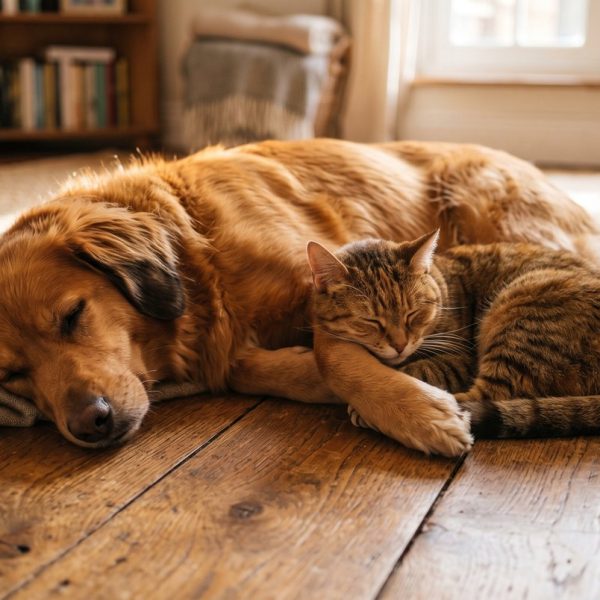
Look closely at a farmyard, a kennel, or a pet shop and a strange pattern starts to appear. Animals that have lived alongside humans for generations often share a curious set of features: floppy ears, patchy coats, shorter snouts, curlier tails. These traits turn up in creatures as different as dogs, pigs, rabbits and cattle, and biologists have a name for the pattern. It is called domestication syndrome, and it remains one of the more intriguing puzzles in the study of how tame animals came to be.
What domestication syndrome actually describes
To understand what is domestication in the first place, it helps to separate it from simple taming. A tamed animal tolerates people. A domesticated one has changed over many generations to live alongside them, passing those changes on to its offspring. Domestication syndrome refers to the cluster of physical and behavioural traits that seem to travel together during that long process. No one deliberately bred animals for floppy ears. Yet floppy ears, along with a handful of other features, keep appearing wherever domestication of animals has taken place.
The traits that give it away
The list is remarkably consistent from one species to the next. Reduced body size, smaller teeth and jaws, white patches or piebald colouring, shortened faces, curled or shortened tails, floppy rather than upright ears, and a longer stretch of youthful behaviour carried into adulthood. Perhaps most importantly, domesticated animals tend to be calmer and less fearful of people. It is as if selecting for one thing, tameness, quietly drags a whole suitcase of other traits along with it.
The fox experiment that made it famous
The clearest evidence comes from a decades-long study in Siberia. Starting in the late 1950s, researchers bred silver foxes for a single quality: friendliness towards humans. Within a few generations the foxes were not only tamer but had begun to look different, with floppy ears, patchy coats and curlier tails. The silver fox experiment is often held up as living proof of the pattern, showing how selecting for behaviour alone can reshape an animal's body. This is why fox domestication remains such a touchstone for anyone studying the subject.
Why would tameness change an animal's looks
The leading explanation involves a group of cells in the early embryo known as neural crest cells. These cells help form many of the tissues affected by domestication, including parts of the adrenal glands that govern fear responses, as well as cartilage, pigment cells and teeth. If domestication gently reduces the activity of these cells, it could soften an animal's fear while also, as a side effect, changing its ears, coat and face. It is a tidy idea, though not the only one, and the research is still unfolding.
What it means for the animals on your sofa
Cats and dogs carry these fingerprints too, if you know where to look. Many dog breeds show the floppy ears and varied coats the theory predicts. Cats, domesticated more recently and more loosely, show the pattern less strongly, which fits their reputation for independence. Even familiar behaviours have roots in this shared history. If you have ever wondered why do cats purr, part of the answer lies in the close bond between people and animals that domestication built over thousands of years.
A puzzle that is still open
Not everyone agrees the syndrome is as neat as it sounds. Some researchers argue the traits are less universal than the classic accounts suggest, and that the fox study has been over-interpreted. That healthy disagreement is part of the appeal. Curious readers can follow the debate in communities like the evolution forum on Reddit, where the fox experiments and the neural crest theory are argued over with real enthusiasm.
Domestication syndrome describes how unrelated species converge on similar traits once they are bred for the same environment. Markets produce a comparable convergence, which is why competing products in a mature category end up almost indistinguishable. Companies commission bespoke software solutions when that sameness stops fitting, and the workflow they actually run no longer resembles the one the market assumes.
Domestication research is a good illustration of how a finding accumulates credibility slowly, across decades and disciplines. No single study established it. Understanding what is peer review explains why that slow accumulation is a feature of the system rather than a delay in it.
Part of a larger story about change
Domestication is really a story about slow change under pressure, and that theme runs well beyond biology. The way species drift and diverge has a loose parallel in the way human languages split and change over centuries. If that comparison appeals, this look at how languages evolve over time traces a similar branching pattern in words rather than genes.
How long does it take
One reason the pattern is so striking is the timescale involved. The silver foxes began to change within a handful of generations, but most farm and companion animals were shaped over thousands of years. Dogs are thought to have parted ways from wolves tens of thousands of years ago, while cats, sheep and cattle followed as farming spread across the world. The pace depends on how strongly humans select for tameness and how quickly a species breeds. Fast-breeding animals can shift within a human lifetime, while slower ones take far longer to reveal the full pattern.
Domestication syndrome is a reminder that evolution rarely changes one thing at a time. Pull on a single thread, such as tameness, and a whole pattern shifts with it. The next time you meet a floppy-eared dog or a gentle farm animal, you are looking at the quiet handiwork of thousands of years of shared life, written into ears, coats and temperaments alike.
Recent Posts
Comment l'homme a façonné l'...

What Thousands of Years of Evo...

How Domestication Radically Ch...

La Evolución Animal Que Nunca...

Editing and Proofreading Make ...